“Finding Balance: The Foundation of Healing for Survivors” ~
The Search for Steady Ground
After trauma, life can feel like a pendulum — swinging between numbness and overwhelm, isolation and connection, silence and noise. Balance isn’t about standing perfectly still. It’s about learning to move with intention, not reaction.
Healing begins when survivors stop chasing extremes and start building steadiness.
1. Emotional Balance — Feeling Without Drowning
Survivors often fear their emotions because they’ve been taught that feeling equals weakness. But emotions are signals, not threats. Balance means allowing sadness, anger, and joy to coexist — without letting any one emotion define you.
Try this: when a wave of emotion rises, breathe and name it. Naming turns chaos into clarity.
2. Physical Balance — Grounding in the Body
Trauma disconnects survivors from their bodies. Reconnecting through movement — walking, stretching, yoga, or even mindful breathing — helps restore a sense of control.
Your body isn’t the enemy. It’s the vessel that carried you through survival and now deserves gentleness.
3. Mental Balance — Quieting the Inner Critic
The mind of a survivor can be a battlefield of “what‑ifs” and “should‑haves.” Balance means learning to challenge those thoughts with truth. Ask: Is this fear current, or is it memory? That question alone can shift your perspective from panic to presence.
4. Spiritual Balance — Reconnecting With Meaning
Whether through prayer, meditation, or reflection, survivors often rediscover peace by reconnecting with something larger than pain. It’s not about religion — it’s about restoration. Spiritual balance reminds survivors that healing is not just recovery; it’s renewal.
5. Relational Balance — Choosing Safe Connections
Healing doesn’t mean trusting everyone again. It means learning to trust wisely. Balance in relationships comes from boundaries — knowing when to open up and when to protect your peace.
Boundaries are not walls; they’re doors with locks you control.
The Art of Stability
Balance is not perfection. It’s practice. It’s the daily decision to return to center — even when life pulls you sideways.
For survivors, stability is not the absence of struggle. It’s the presence of self‑trust.
Closing Reflection
You don’t have to be unshakable to be strong. You just have to keep finding your footing — one breath, one boundary, one moment at a time.
Balance isn’t the end of healing. It’s the rhythm that keeps you moving forward.
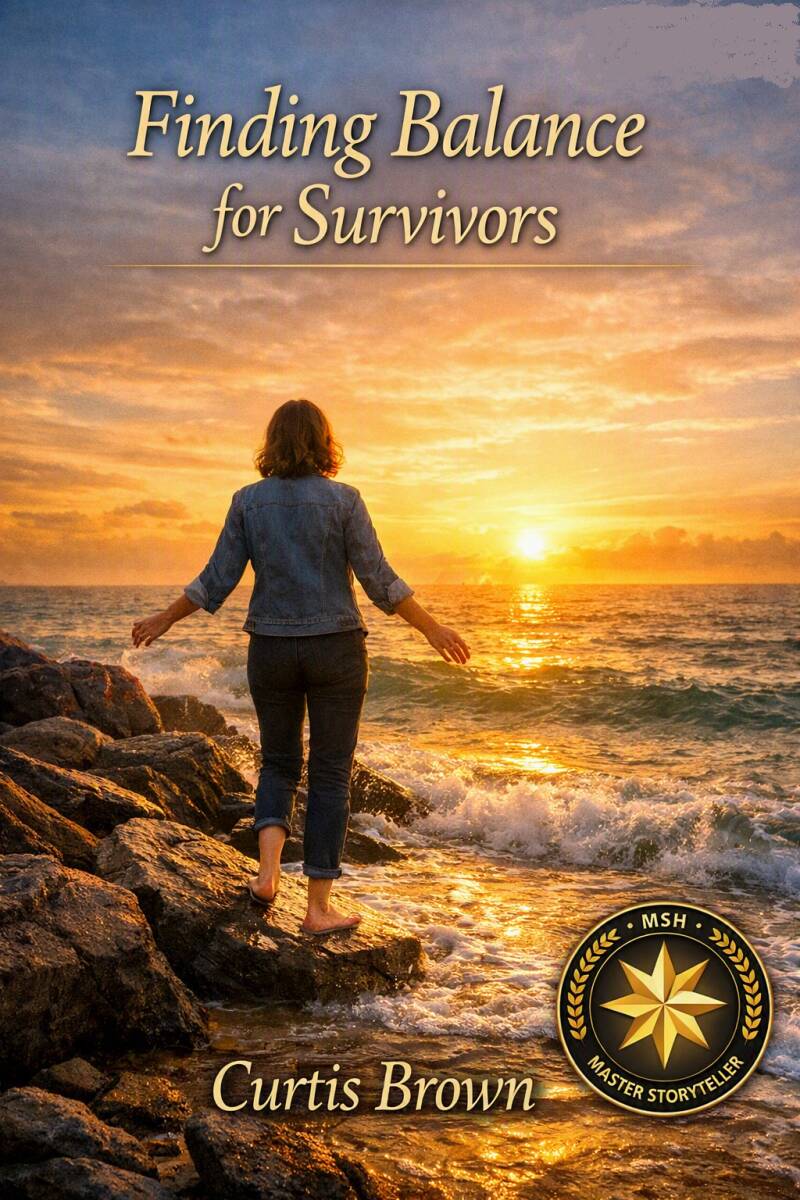
“The Center Returns”
The storm once called your name, and you answered — trembling, brave, alive. Winds tore through your silence, but even chaos could not claim your soul.
Now the tide recedes. The air softens. You stand between what was and what will be — barefoot on the edge of becoming.
Balance is not stillness. It is motion with meaning. It is the breath between fear and faith, the heartbeat that whispers, I am here.
You learn to walk again — not on the shards of memory, but on the stones of self‑trust. Each step a promise: I will not drown in my own depth. I will rise with my own rhythm.
The sun does not rush its ascent. Neither should you. Healing is a season, and balance is its dawn.
Prayers,
Curtis
Add comment
Comments