Products to help with anxiety, depression, etc.
Mandie's Safe Haven is a sanctuary for survivors of sexual abuse seeking healing and support. Our blog aims to provide a safe space for sharing stories, finding resources, and fostering a community of support and empowerment. Feel free to offer suggestions on ideas and products you feel will benefit our audience.

Products to help with anxiety, depression, etc.
I have recently been asked if there are gadgets, books, or tools I use to combat fatigue, mindfulness, depression, and anxiety.
With that said I searched products I use and those I found interesting as well as those that can help with mental disorders. These are not prescription medications, these are tools that I use to combat stressors, or am anxious and need to clear my mind.
I realize when it comes to multivitamins or supplements, everybody's reaction is different, so i chose to leave those out at this time. If you know of a product or idea that can help other's please feel free to let me know .
Mandie Safe Haven exists to serve your needs!

Let me say this clearly: What happened to you was not your fault. You did not deserve the humiliation, the fear, the coercion, or the cruelty. The pain inflicted upon you does not define who you are. You are more than what was done to you—you are resilient, you are worthy, and you are capable of creating a life that feels safe, joyful, and meaningful.
This book is not a quick fix. Healing is not linear, and it’s not about forgetting the past. It’s about reclaiming your power in the present. The practices you’ll find here—especially mindfulness—have the potential to transform the way you relate to your thoughts, emotions, and body. They’ve helped me rebuild my own life after trauma, and I believe they can help you, too.

Why We Fear Change
Change is inevitable. From the moment we are born, life is in constant motion—our bodies grow, our relationships evolve, and the world around us shifts. And yet, for something so natural and continuous, change is one of the most universally feared aspects of life. Why? Why do we cling to comfort zones even when they no longer serve us? Why do we resist the very transformations that could elevate our lives?
What Do You Really Fear?
A Self-Discovery Quiz to Understand the Root of Your Resistance to Change

Reader Takeaways
By the end of the book, readers will have:
-
A personalized 10-minute daily practice
-
The ability to adapt techniques to different situations
-
An understanding of how and why meditation works
-
Tools to overcome common obstacles
-
Confidence in their capacity to meditate effectively
-
Measurable improvements in stress levels, focus, and emotional balance
This comprehensive yet approachable guide fills the gap between overly simplified meditation apps and intimidatingly complex traditional texts, offering readers a sustainable path to incorporating meditation into their modern lives.

Summary
The Identity Compass offers a different path.
Rather than chasing someone else's definition of success, you'll learn how to define success according to your own values and create a life built on meaning, integrity, contribution, and personal fulfillment.
Whether you're navigating a career change, recovering from disappointment, searching for greater purpose, entering a new season of life, or simply ready to become the person you've always known you could be, this book provides the clarity and practical guidance to help you move forward.
This is more than a book about self-discovery.
It's a roadmap for intentional transformation.
Identity isn't something you accidentally find.
It's something you intentionally build.
The journey begins with awareness.
It grows through courageous choices.
It is strengthened by consistent action.
Becoming visible in the life you create every day.
Stop living by default and start living by design.
You're ready to replace fear with confidence, confusion with clarity, and self-doubt with purpose...
Your journey to become more fully yourself than ever before.starts here.
Inside The Identity Compass, you'll discover that purpose isn't a destination—it's the natural result of living each day in alignment with the person you choose to become.

This book incorporates several proven strategies to overcome the damage caused by abuse.
This book isn’t about rushing, fixing, or forcing yourself to “move on.” Healing is not a straight line, and it is never about pretending the past didn’t happen. Instead, these pages are here to walk beside you—to offer comfort, practices, and space for your voice.
You will find tools like gratitude, mindfulness, storytelling, and journaling woven throughout. These are not magic cures, but they are gentle anchors. Gratitude reminds us that even in dark times, small lights exist. Mindfulness teaches us to return to the safety of the present. Storytelling helps us reclaim power from the past. Journaling gives us a place to put down what is too heavy to carry inside

"I knew something was wrong. Everyone knew. Why didn't anyone do anything?"
This is the question that echoes through survivor testimonies, court transcripts, investigative reports, and private confessions. It's the question asked by children who were abused while teachers, coaches, and neighbors watched. By domestic violence victims whose friends and family knew but stayed silent. By workplace harassment survivors whose colleagues witnessed but said nothing. By elderly people neglected in care facilities with staff all around them.
Why didn't anyone help?
It's also the question that haunts witnesses years after the fact. The coworker who saw harassment but didn't report it. The neighbor who heard domestic violence through the walls but never called police. The family member who suspected child abuse but convinced themselves they were imagining things. The colleague who knew about financial exploitation but didn't want to get involved.
Why didn't I do something?
This book exists in the space between these two questions—between victims asking "why didn't you help?" and witnesses asking "why didn't I help?" Between the abandonment survivors experience and the paralysis witnesses feel.

USING CUTTING-EDGE RESEARCH, this book demonstrates that the underlying reason for the majority of anxiety and depression is sensitization of certain areas of the brain and learned neural pathways. Dr. Schubiner has used this new understanding to develop a unique program to actually reverse anxiety and depression. By reading this book, you'll be able to determine if you have this syndrome and how to overcome it. The program in this book gives instruction on emotional processing, therapeutic writing exercises, and everything else you need to unlearn your anxiety and depression. Access to online audio meditation exercises is included with purchase. Note: The final 7 chapters and the audio meditations are identical to that of Unlearn Your Pain, third edition. You can obtain the first 5 chapters on the kindle version.

The groundbreaking 7-week plan for managing anxiety and depression using cognitive behavioral therapy.
Cognitive behavioral therapy (CBT) is one of the most effective techniques for finding relief from depression and anxiety. With this CBT workbook for mental health, psychologist Dr. Seth Gillihan uses his 15 years of experience treating patients to develop a 7-week plan that teaches you practical CBT techniques to help you feel better.

There is a moment that many survivors describe in almost identical terms. They are standing in a kitchen, or sitting in a parked car, or lying awake in the dark, and something inside them — some small, exhausted, but still-living part — says: this is not okay. Not out loud. Not yet in words. But it is there. A knowing. A flicker.
Finding the Strength was written for that flicker. This is a book for anyone who has experienced physical, emotional, or sexual abuse in an intimate relationship — whether they are still inside it, in the fragile and dangerous process of leaving, or years out and still carrying the weight of what happened in ways they cannot always explain. It is a book for the person who has been told so many times that they were overreacting, imagining things, or simply not remembering correctly that they have begun to believe it. And it is for the person who is out and technically safe, but who wonders whether they will ever feel entirely like themselves again.
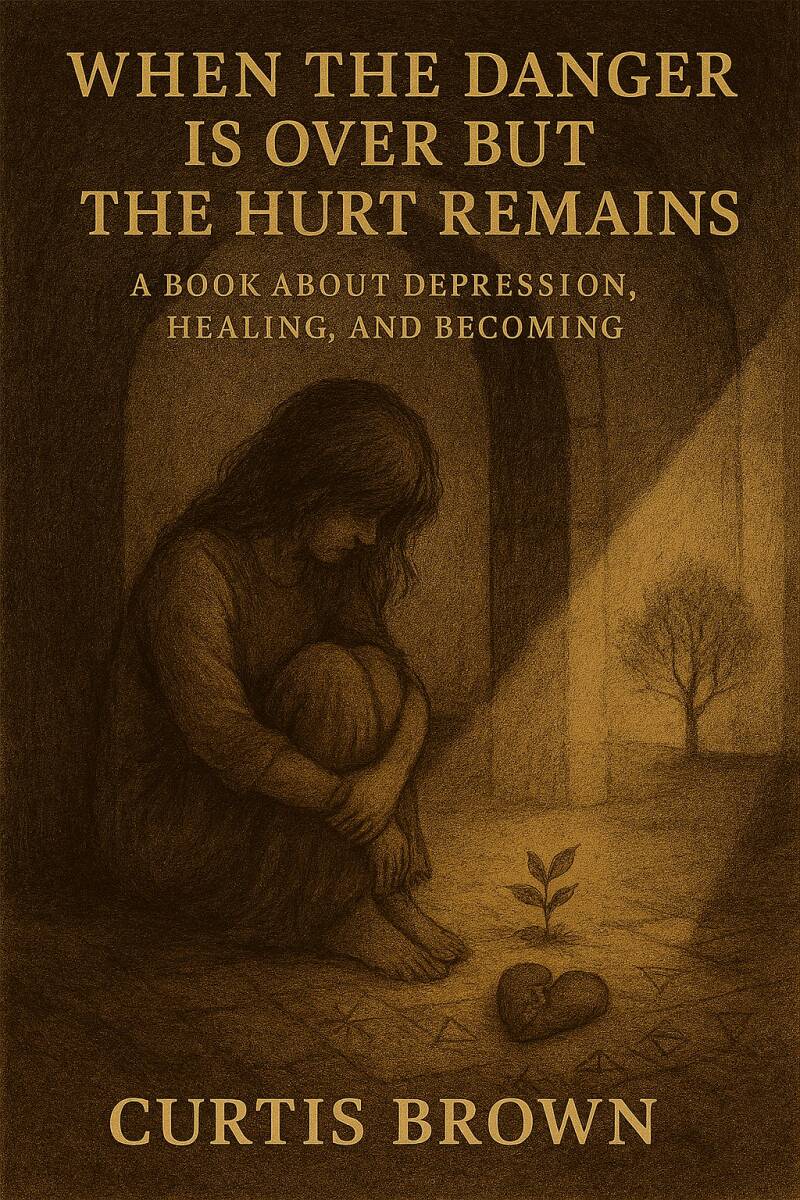
You survived trauma.
You endured abuse.
You carried loss, responsibility, chaos, or pain longer than you should have had to.
You held it together when there was no room to fall apart.
And now—when life is supposed to feel safer, lighter, or more stable—you feel exhausted, numb, disconnected, or heavy in ways you can’t explain.
Depression After Survival Is Different
Depression that follows survival is often misunderstood—by professionals, by loved ones, and by the people experiencing it. It doesn’t arrive with drama. It arrives with silence.
It shows up as:
-
Emotional flatness instead of sadness
-
Fatigue that sleep doesn’t touch
-
A loss of meaning rather than a loss of function
-
A body that feels done long before the mind understands why
When you live in survival for too long, your body and mind prioritize endurance over processing. You don’t feel everything when it’s happening—you feel it when it’s safe enough to feel at all. Depression, in this context, isn’t weakness. It’s delayed impact.

The Mindset That Changes Everything
The Asset Mindset is not about becoming rich overnight.
It is not about chasing trends.
It is not about finding shortcuts.
It is about seeing the world differently.
Instead of asking:
How can I earn more?
You begin asking:
What can I build?
Instead of focusing only on today's paycheck, you focus on tomorrow's possibilities.
Instead of trading every hour for income, you invest some of those hours into ownership.
Because every meaningful asset begins with a decision.
A decision to create rather than consume.
A decision to build rather than wait.
A decision to think beyond immediate rewards.
The people who thrive in the digital economy are not necessarily those who work the hardest.
They are often the ones who learn to direct their effort into assets that continue working long after the initial effort is complete.
That is the Asset Mindset.
And once you develop it, you never look at time, work, or opportunity the same way again.

You were never “broken” — you were programmed.
"That single idea alone changed the way I viewed my entire life."
The author brilliantly explains how subconscious conditioning shapes identity, behavior, emotional reactions, fear, self-sabotage, anxiety, relationship patterns, confidence, and even the internal voice we hear every day. The book helps readers understand that many destructive thought patterns are not signs of weakness or failure but learned survival responses shaped by repetition, trauma, criticism, rejection, fear, and the environment.
The writing style is powerful, emotionally intelligent, and deeply human. At multiple points, I had to stop reading because it felt like the author somehow understood thoughts and emotional struggles I had never fully put into words myself. The sections discussing inner dialogue, emotional survival patterns, subconscious scripting, fear conditioning, nervous system responses, and identity loops were absolutely eye-opening.