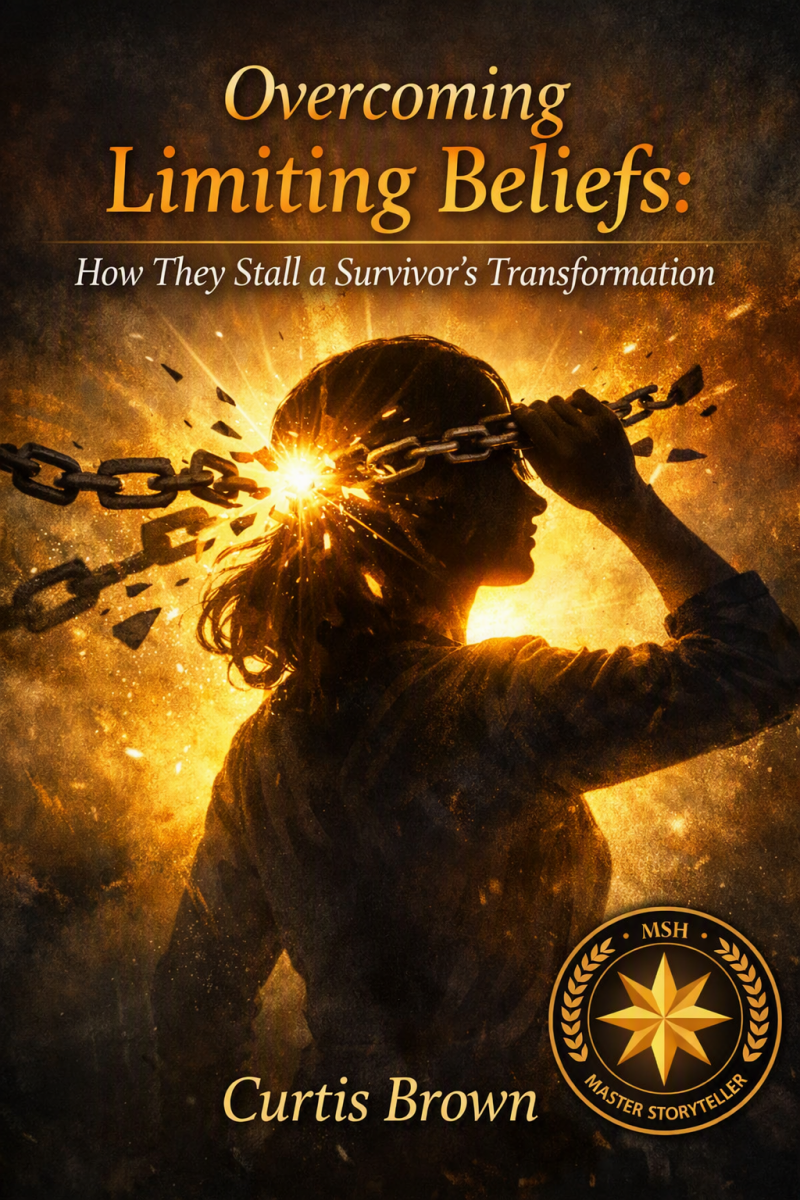
In order to follow our dreams, goals, aspirations, desires, etc,; We must understand what is holding us back. There are two factors we must consider when it comes to wanting to change.
1) Internal - our current beliefs and understanding of how our world works.
We impose false facts about what we are capable of doing and it becomes part of our belief system.
2) External - These include factors like income, physical limitations, environment.
The truth is we can change our life by adopting a different belief system.
Prayers,
Curtis

I am almost completed with this new book and wanted to give you an important chapter I feel can benefit you Free Download
Overcoming Limiting Beliefs: How They Stall a Survivor’s Transformation ~
The mind can hold you long after the trauma is gone.
Limiting beliefs are the quiet barriers survivors don’t always see. They’re not loud. They’re not dramatic. They’re subtle — woven into thoughts, reactions, and self‑perception. And because they feel familiar, survivors often mistake them for truth.
But limiting beliefs are not truth. They are echoes of old pain.
The Hidden Power of Limiting Beliefs
Trauma teaches the nervous system to expect danger. Manipulation teaches the mind to expect failure. Abuse teaches the heart to expect disappointment.
From these experiences, limiting beliefs form:
-
“I’m not capable.”
-
“I’ll always be this way.”
-
“I don’t deserve better.”
-
“I can’t trust myself.”
-
“Change is too risky.”
These beliefs don’t just slow transformation — they stall it completely.
They keep survivors standing at the threshold of healing, afraid to step forward.
Where Limiting Beliefs Come From
Limiting beliefs are learned in moments of vulnerability:
-
A narcissist’s criticism repeated until it sounded like fact
-
A childhood where safety was unpredictable
-
A relationship where your voice was dismissed
-
A trauma that taught your body to brace for impact
Survivors adapt to survive — but those adaptations become cages later.
How Limiting Beliefs Stall Transformation
1. They distort identity
Survivors begin to see themselves through the lens of fear instead of truth. Transformation requires identity shifts — limiting beliefs block that shift.
2. They sabotage progress
Every step forward is met with internal resistance: “Who do you think you are?” This creates emotional paralysis.
3. They reinforce old patterns
Even when survivors want change, limiting beliefs pull them back into familiar pain. The mind chooses the known over the unknown.
4. They create fear of success
Survivors may fear becoming stronger because strength threatens the old narrative. Limiting beliefs protect the past instead of the future.
Breaking Free: Rewriting the Internal Story
Step 1: Name the belief
You cannot fight what you cannot see. Naming the belief exposes the lie.
Step 2: Identify its origin
Ask: Who taught me this? Most limiting beliefs were inherited, not chosen.
Step 3: Challenge the narrative
Ask: Is this belief current, or is it a memory? Truth dissolves distortion.
Step 4: Replace it with grounded truth
Not a cliché — a truth rooted in your lived strength. Example: “I survived what tried to break me. I can survive becoming.”
The Survivor’s Turning Point
Transformation begins the moment a survivor realizes:
The cage was never locked. It was built from beliefs that can be dismantled.
When limiting beliefs fall away, survivors don’t just change — they rise.
Closing Reflection
Your mind is not your enemy. It is a storyteller that learned to protect you. Now it’s time to teach it a new story — one where you are capable, worthy, and becoming.
You are not limited. You are learning to unlearn the lies.
Add comment
Comments