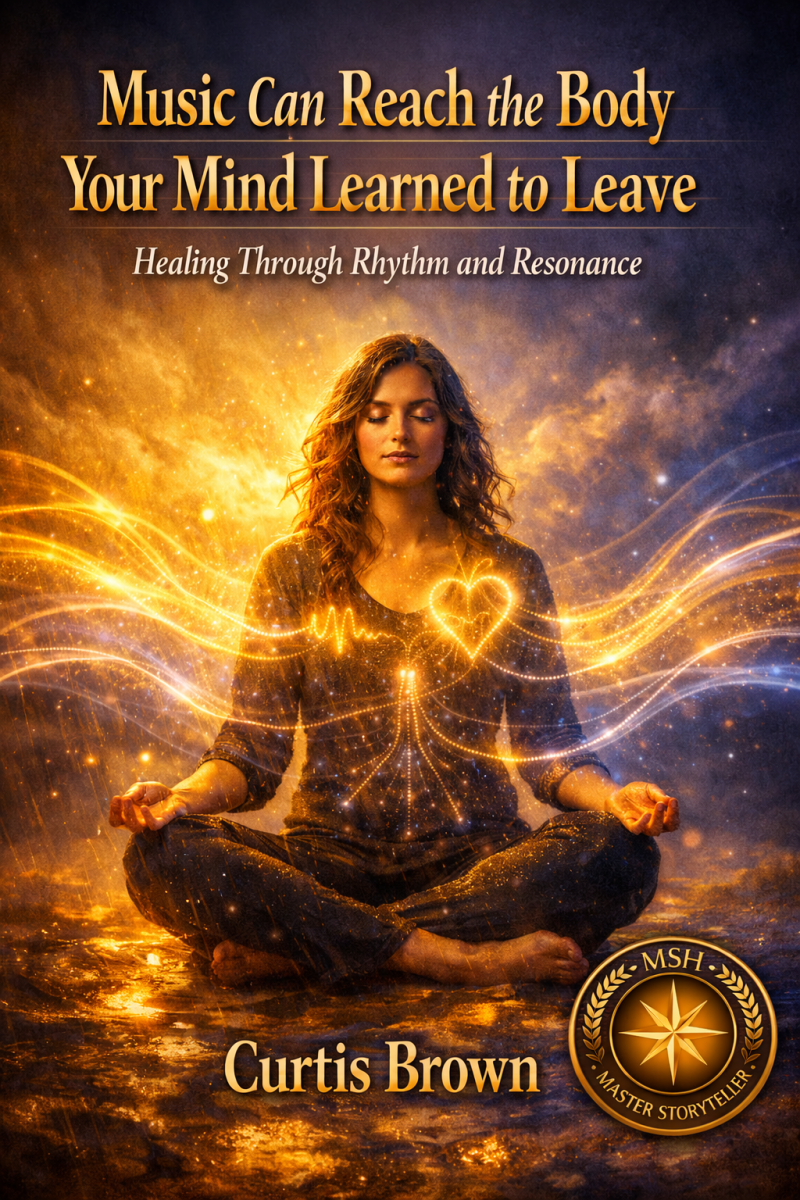
Healing Through Rhythm and Resonance
There are moments in trauma recovery when words fall short — when the body holds stories the mind can’t yet speak. In those moments, music becomes more than sound. It becomes a bridge.
Music therapy isn’t about performance or perfection. It’s about vibration — the way rhythm travels through the skin, the bones, the nervous system. It’s about how melody can reach the places silence has guarded for years.
🎵 The Body Remembers What the Mind Forgot
After trauma, the body often learns to disconnect — to survive by leaving itself behind. Muscles tighten, breath shortens, and movement feels foreign. Music changes that. When a drumbeat echoes through the chest or a cello hums against the skin, the body begins to listen again. It remembers its own rhythm. It remembers safety.
Sound bypasses the intellect and speaks directly to the nervous system. It says, You are still here.
💫 Vibration as Connection
Every note is a vibration — a pulse that mirrors the heartbeat. When survivors engage with music, they’re not just hearing; they’re feeling. That vibration becomes a dialogue between body and mind, a gentle invitation to return home.
Music therapy uses rhythm and tone to regulate the body’s stress response. Slow, steady beats can calm the heart rate; melodic patterns can synchronize breathing. Over time, these sensations rebuild trust between the body and the self.
🌈 The Courage to Feel Again
For many survivors, feeling anything can be terrifying. Music offers a safe way to begin. A song can hold emotion without judgment. A melody can express grief, joy, or longing without words. Through sound, survivors can explore emotion at a pace their bodies can handle.
This is the quiet courage of healing — not rushing, not forcing, but allowing the body to speak through rhythm.
🌅 Music as a Path Back to Wholeness
Music therapy reminds us that healing isn’t linear. It’s cyclical — like rhythm itself. Each beat, each breath, each note is a step toward reconnection.
When survivors listen, sing, or play, they’re not escaping their pain; they’re transforming it. They’re learning to inhabit the body again — to feel the pulse of life beneath the scars.
✨ Closing Reflection
Music reaches where words cannot. It moves through the spaces trauma left behind and whispers, You are safe to return. It teaches the body to trust the mind again — and the mind to listen to the body’s song.
Healing through music is not about forgetting the past. It’s about remembering that you are still whole, still alive, and still capable of harmony.
Music Can Reach the Body Your Mind Learned to Leave ~
There's a version of you that learned how to leave your own body without going anywhere.
You were still standing in the room. Still nodding, still breathing, still doing whatever it took to get through the next five minutes. But you weren't in there. You were somewhere above it, or behind it, or nowhere at all — watching yourself the way you'd watch a stranger. That wasn't weakness. That was your body doing exactly what it was built to do when staying present wasn't safe.
The problem is, that skill doesn't turn off just because the danger did.
Years later, you can be sitting somewhere completely safe — your own kitchen, a friend's couch, a therapist's office — and still feel like you're watching your life through glass. Talking about what happened doesn't always help, because the parts of you that hold the memory of danger aren't the parts that use words. Trauma doesn't live in a sentence. It lives lower than that — in the shoulders that won't drop, the jaw that won't unclench, the breath that stays shallow because deep breathing once meant being noticed.
This is where most advice runs out. "Talk about it." "Process it." "Name what you're feeling." All useful, eventually. None of it reaches a body that's been in lockdown for years, because a body in lockdown isn't waiting for the right words. It's waiting for proof that it's safe to come back.
Music is one of the few things that can offer that proof without asking you to explain anything first.
Why this works when talking doesn't
Rhythm is physical before it's emotional. A steady beat can slow a racing heart rate. Bass you feel in your chest can remind a body what it feels like to be moved by something instead of braced against it. This isn't "put on a happy playlist and you'll feel better" — real music therapy, done with a trained therapist, uses rhythm, tone, and movement deliberately, the way a physical therapist uses specific exercises for a specific injury.
What reconnecting actually feels like
It's rarely dramatic. More often it's small and almost embarrassing in how ordinary it is: your foot taps before you notice it's tapping. Your shoulders drop half an inch without you telling them to. A song comes on and for four minutes you forget to keep watch. You get it back in four-minute doses, over and over, until four minutes turns into an afternoon.
If you've lost music too
Some of you don't have a song that does this anymore. Trauma has a way of contaminating things that used to be safe. If that's you, this isn't a dead end — it means the work starts with finding new sound, not forcing old sound to mean something it can't mean anymore.
What to do with this
You don't need a therapist's office to start. Put on something with a strong, steady rhythm. Don't analyze it, don't judge whether you're doing it "right" — just notice whether your breath changes, whether anything in you unclenches. If you want to go further, look for a board-certified music therapist (credential: MT-BC), not someone offering "sound healing" with no clinical training behind it.
Your body didn't leave because it was broken. It left because it was smart enough to protect you. It can learn, slowly, that it's allowed to come back — and it doesn't need your permission in words to start.
We went to a jelly Roll concert recently, and it inspired me to research the benefits of music therapy.
Personally, I enjoy a variety of different music genres. I'll admit I appreciate the music of the 80's. It automatically makes me feel great.
Go ask your therapist or research it yourself and see how powerful music can be.
Prayers,
Curtis
Add comment
Comments