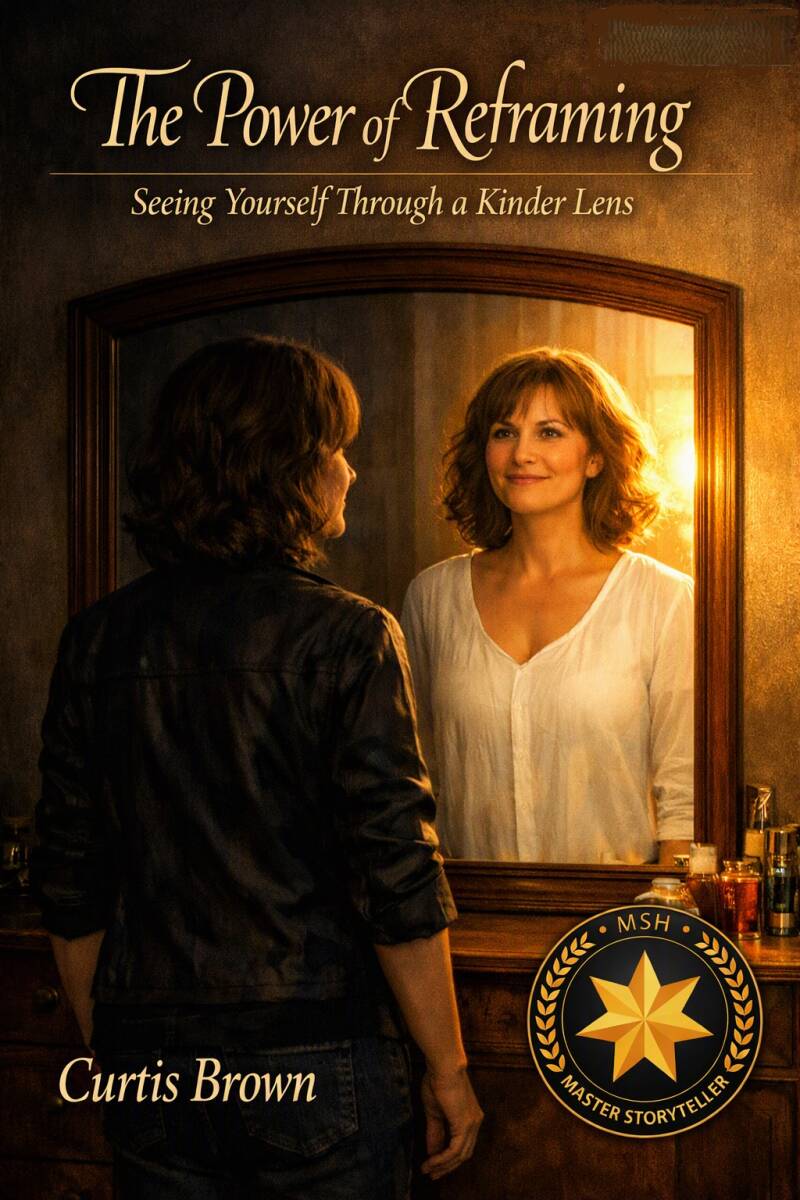
For years, Sarah described herself with one word:
Weak.
She had stayed in an abusive relationship longer than she believed she should have. Whenever she looked back, she judged herself through the person she was today.
I should have left sooner.
I should have stood up for myself.
I should have known better.
One afternoon, while talking with a friend, Sarah said quietly, “I wasted six years of my life because I wasn't strong enough to leave.”
Her friend didn't argue with her. She simply asked:
“What if staying doesn't prove you were weak? What if it shows how hard you were trying to survive a situation you hadn't yet learned how to escape?”
Sarah became silent.
She had never looked at herself that way.
For years, she had measured her past self by everything she knew now—the warning signs she could recognize now, the boundaries she could set now, and the strength she had built now.
She had never considered the frightened woman who had been doing the best she could with what she understood then.
That afternoon, the facts of Sarah's story didn't change.
But the meaning she attached to them began to.
I was weak became:
I was surviving.
I wasted six years became:
I spent six years learning what I never want to accept again.
I should have known better became:
I know better now, and I can use what I've learned.
That is the power of reframing.
Reframing doesn't ask you to pretend the painful things didn't happen. It doesn't turn abuse into something positive or excuse the person who caused harm.
It simply asks you to stop using your past as evidence against yourself.
Sometimes healing begins when we ask a different question.
Instead of:
“What's wrong with me?”
Try:
“What was I trying to survive?”
Instead of:
“Why wasn't I stronger?”
Try:
“What strength did it take to make it this far?”
Instead of looking backward with the knowledge you have today and condemning the person you were then, try looking at that person with compassion.
They didn't have everything you know now.
They were still learning.
Still trying.
Still surviving.
And perhaps the kinder lens is also the more truthful one.
You cannot rewrite what happened to you. But you can change the story you tell yourself about who you were while you were surviving it—and who you are becoming now.
The Power of Reframing — Seeing Yourself Through a Kinder Lens ~
When Perception Feels Heavy
Survivors often carry invisible mirrors — reflections shaped by judgment, misunderstanding, or self‑criticism. You might hear echoes of what others once said, or replay your own doubts. But those reflections aren’t reality; they’re residue. Healing begins when you learn to see yourself through compassion, not comparison.
How to Reframe What Others Think
-
Separate opinion from identity — what others think is a projection, not a definition.
-
Challenge your inner critic — ask, “Is this thought true, or just familiar?”
-
Replace judgment with curiosity — instead of “Why did they think that?”, try “What does this teach me about me?”
-
Anchor in your values — your worth isn’t up for debate; it’s grounded in who you are.
-
Practice self‑compassion — speak to yourself the way you’d speak to someone you love.
Reframing How You See Yourself
Healing reframes the mirror. You begin to notice strength where you once saw scars, courage where you once saw fear. You stop asking, “What do they think of me?” and start asking, “What do I know about myself?”
Closing Reflection
You are not the sum of opinions — you are the author of your own reflection. When you reframe perception, you reclaim power. And every time you choose self‑understanding over self‑judgment, you step closer to peace.
Know this "It was not your Fault", and "You are not Alone"
When you repeatedly get told something over and over again, you start to believe the lies. I mean who wouldn't?
Knowing the labels people or even yourself place on you, are not true, unless you allow them to be. Changing your perception and negative beliefs can elevate you,
Prayers,
Curtis
What makes this book different is that it does not shame the reader, oversimplify pain, or pretend that transformation happens overnight. Instead, it explains something incredibly powerful in a grounded and compassionate way:
You were never “broken” — you were programmed.
That single idea alone changed the way I viewed my entire life.
The author brilliantly explains how subconscious conditioning shapes identity, behavior, emotional reactions, fear, self-sabotage, anxiety, relationship patterns, confidence, and even the internal voice we hear every day. The book helps readers understand that many destructive thought patterns are not signs of weakness or failure but learned survival responses shaped by repetition, trauma, criticism, rejection, fear, and the environment.
The writing style is powerful, emotionally intelligent, and deeply human. At multiple points, I had to stop reading because it felt like the author somehow understood thoughts and emotional struggles I had never fully put into words myself. The sections discussing inner dialogue, emotional survival patterns, subconscious scripting, fear conditioning, nervous system responses, and identity loops were absolutely eye-opening.
One of the strongest elements of the book is how it reframes healing.
Instead of asking:
“What is wrong with you?”
…it asks:
“What happened to you, and what were you conditioned to believe about yourself?”
That shift alone creates enormous emotional relief
Add comment
Comments