A moment for you
These are invitations, not assignments. Take only what is useful right now.
Is there someone in your life who, when you have watched them with others in difficulty, stays present without immediately trying to fix things? Who comes to mind?
What is the thing you are most afraid the person you tell will do or say? Knowing that fear clearly — is it pointing you toward a specific quality to look for in who you choose?
If you were to begin a conversation with your one safe person, what is the first sentence you might say? It does not have to be perfect. It only has to open the door.
What do you need from the person you tell? Not what you expect, or what you think is reasonable to ask for — what do you actually need? Can you name it?
You deserve to be heard by someone who will not flinch. That person exists. Finding them is not a betrayal, or an escalation, or a point of no return. It is the next step on a road that you are already walking.
Prayers,
Curtis Brown
I am hoping to complete the full publication within 2 weeks,
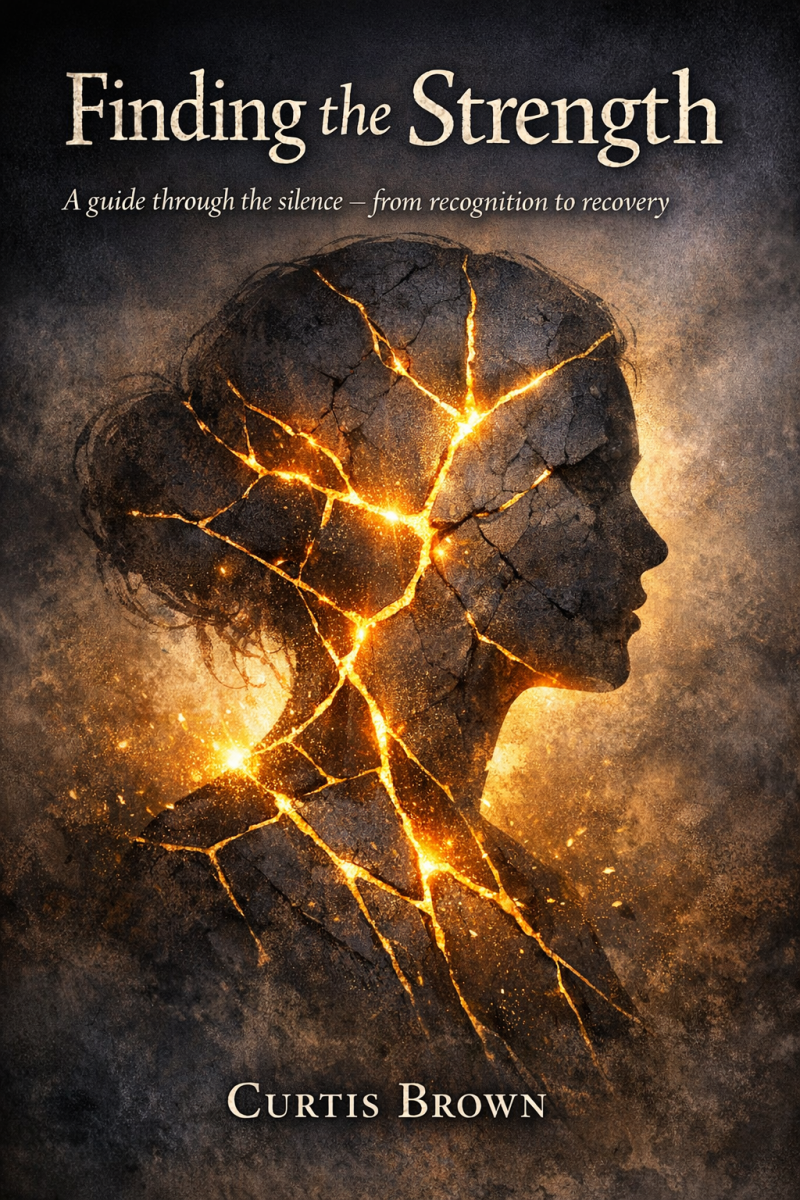
Finding the Strength
A guide through the silence - from recognition to recovery ~
First, I want to thank all of you who have given me the courage to write such a fantastic and inspirational book. I have included real life examples of what some of you may have gone through, or still going through.
WARNING:
A note before you begin Safety + content warning
Introduction Why this book exists — and who it's for
How to use this book Reading at your own pace, safely
I wanted to add this before we dive into how powerful and impactful this book will be.
Here is a small part of a chapter I created:
"After the conversation
A first disclosure does not end when the conversation does. There is a period afterward — sometimes hours, sometimes days — that can feel disorienting, exposed, and surprisingly difficult even when the conversation itself went well.
Some things that are normal in the aftermath of a first disclosure:
Second-guessing. Did I say too much? Did I exaggerate? Should I have waited? Should I not have said it at all? This internal reversal is not a sign that you made a mistake. It is the mind’s habitual response to vulnerability — the same impulse that has been pulling you back from disclosure for months or years, doing its last work after the door has already been opened. Notice it. You do not have to act on it.
A wave of feeling. Some survivors feel an enormous release after speaking. Some feel a wave of grief, or fear, or anger that had been compressed under the weight of silence. Some feel nothing immediately and then feel a great deal a day or two later. None of these responses is wrong. The feeling is the truth surfacing. Let it.
Uncertainty about what comes next. A first disclosure does not automatically come with a clear next step, and that uncertainty is legitimate. You have done the thing. You do not have to immediately know what it means or what follows. The next step will become clearer in time. You are allowed to let it.
The need to withdraw for a while. Some survivors go quiet after a first disclosure, pulling back from the person they told and from the subject itself. This is not uncommon, and it does not mean the disclosure was a mistake. It means the threshold was significant, and you need time to integrate what you have done. A good safe person will allow this without taking it personally.
If the conversation went well, it is worth letting yourself acknowledge that. Not because you now have to feel grateful or relieved on schedule, but because you did something genuinely hard. You said a true thing to another person. Whatever comes next, that is real, and it is yours, and nothing that happens afterward can take it back.
Blessing’s story | six months later
I thought, after I told her, that I would feel lighter. I’d heard people say that — that telling someone lifts the weight.
What I actually felt was more like — cracked open. Not in a bad way, exactly. More like something that had been sealed for a very long time had been unsealed, and now air was getting in, and that was uncomfortable and also necessary.
I cried a lot that week. Not about anything in particular, just — I cried. Things I had not let myself feel for years started to surface, the way things surface when the pressure is finally lifted.
She checked in with me twice. Not pressing, just: “How are you doing?” Both times, I said something like “it’s a lot” and she said “I know” and that was enough.
About three months after that first conversation, I told my sister. And then, the month after that, I called a helpline and spoke to someone for the first time about what my practical options were.
None of it happened quickly. But every step was possible because of that first one. The book group woman at the kitchen table, and the tea towel she put down, and the way she said “Yes, of course.”
That’s all it took to start. One person willing to put down what they were holding and pay attention."
Add comment
Comments