PTSD Doesn't Pick One Fight. It Comes At You From Everywhere. ~
Nobody tells you that surviving the thing was supposed to be the hard part.
You made it out. You're safe now, or safer, or at least not standing in the middle of it anymore. And somehow that's when the real siege starts — because PTSD doesn't hit you once and let you recover. It comes from everywhere at once, and just when you've steadied yourself against one front, another one opens.
That's not you being weak or dramatic. That's an accurate description of what's actually happening to you.
The front you can't outrun: your own body
Your heart rate spikes over nothing — a slammed door, a raised voice two rooms away, a tone that sounds almost like something else. You can't out-logic this front. Telling your heart rate "we're safe now" doesn't reach it, because it isn't listening to your thoughts. It's listening to pattern-matches your thoughts don't even control.
The front you can't close the door on: memory
Trauma memories don't file the way ordinary memories do. They intrude — a smell, a specific angle of light, an unrelated sentence — and suddenly you're not remembering the past, you're back inside it. That's why "just don't think about it" has never once worked for you. You didn't choose to think about it. It arrived.
The front inside your own relationships
This one is cruelest because it looks like your fault from the outside. You pull away from people who never hurt you, read danger into a delayed text or a flat tone, because your radar was calibrated by someone who actually was dangerous. So you defend against people who deserve none of it, and then carry the guilt on top of everything else. Two fronts stacked on each other: the fear, and the shame about having it.
The front inside your own sleep
Even the hours you're supposed to rest aren't a break. Nightmares replay it. Hypervigilance keeps part of you on watch even unconscious. The one place meant to be automatic recovery turns into another shift on duty.
Why "just relax" was never going to work
You're not fighting a bad memory, or anxiety, or a strained relationship. You're fighting all of it, simultaneously. Anyone who tells you to just calm down has no idea how many fronts are actually open at once.
What actually helps when the attack is on every side
You don't win a siege on five fronts by fighting all five at full strength — nobody could. What works is picking one front at a time: a grounding technique for the body-front, a trauma-informed therapist (EMDR or somatic work) for the memory-front, one honest conversation with one safe person for the relationship-front, an unglamorous nightly wind-down routine for the sleep-front. None of these close all five at once. That's not the goal. The goal is defending one position at a time, deliberately — the difference between being under siege and being under siege with a strategy.
What to do with this
Name your fronts — body, memory, relationships, sleep, whatever applies to you. Seeing them written down turns one overwhelming, formless thing called "PTSD" into several specific, addressable problems. Then pick the loudest front right now and find one small, repeatable thing to do about just that one. You're not required to win the whole siege today. You're required to hold one position, then another.
You're not broken because you're fighting on every front. You're fighting on every front because what happened to you actually was that big. Surviving it once was the first part. Fighting it on every front, one position at a time, is the second — and you're still standing in the field. That's not nothing. That's the whole thing.
I chose to write about PTSD because some battle fronts are still being fought. I have a close friend of mine who has suffered and struggled with his own inner demons. Somewhere he lost sight of what friends and family are for and has given up the fight, he felt helpless and discarded by life's challenges.
I want you to know that sometimes sharing your story offers insights and hope that ALL is not lost, and to continue the good fight at all costs.
If you cannot help those that need it, I recommend a silent prayer to let yourself or your "friend", know they are not alone and pray for their/your reconciliation of life's challenges.
With deepest Prayers,
Curtis & The MSH team
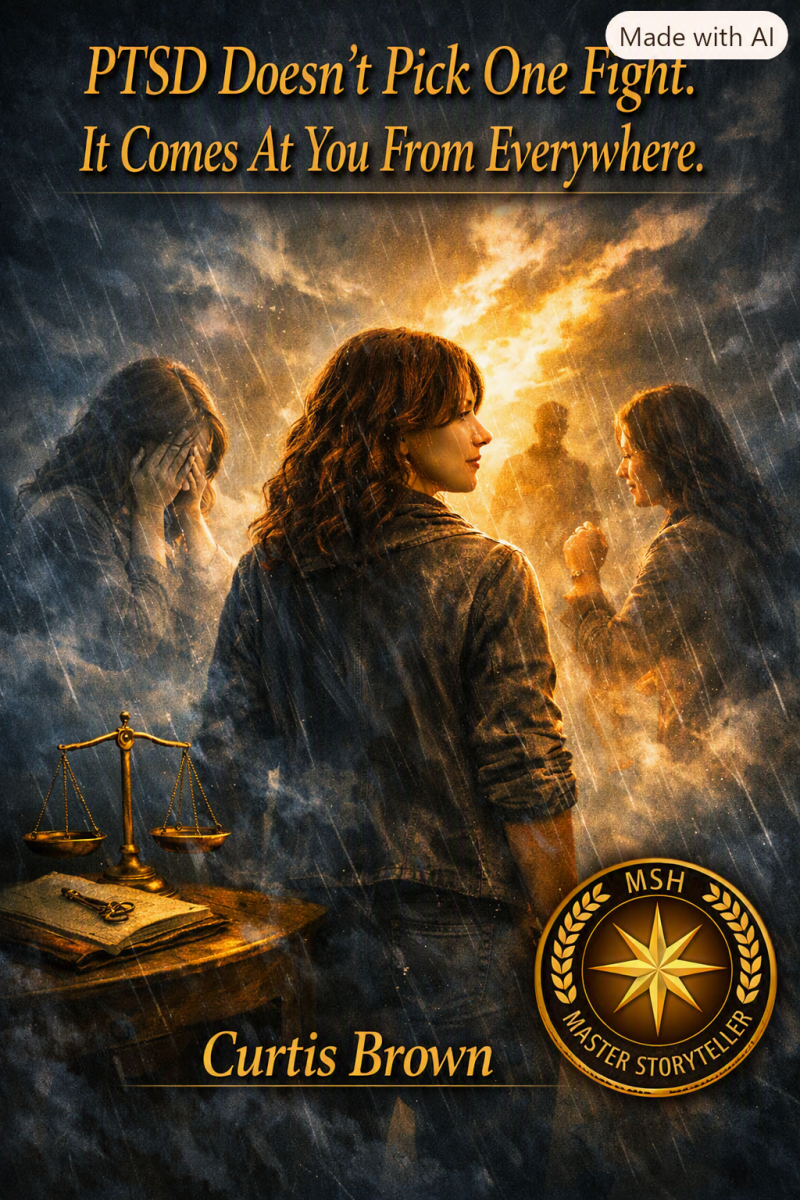
Learning to Stand in the Crossfire of Memory
PTSD doesn’t wait for permission. It doesn’t knock politely or choose a single battlefield. It shows up in the grocery store aisle, in the quiet of your bedroom, in the sound of laughter that suddenly feels too loud. It’s not one fight — it’s all of them, replayed in fragments, disguised as ordinary moments.
⚡ The Unseen War
For survivors, trauma doesn’t end when the event does. The body keeps score, the mind keeps watch, and the heart keeps asking, “Am I safe yet?” PTSD turns everyday life into a minefield — not because you’re weak, but because your nervous system learned to protect you by never letting its guard down.
It’s exhausting. It’s invisible. And it’s real.
But here’s the truth: you are not fighting yourself. You’re fighting the echoes of what happened — echoes that can be quieted, retrained, and eventually transformed.
🌧️ When the Storm Comes From All Directions
PTSD doesn’t attack in straight lines. It circles. It ambushes. It whispers. One moment you’re fine, and the next, your body is reacting to something your mind can’t even name.
That’s because trauma rewires perception. The brain begins to see danger everywhere — not out of paranoia, but out of memory. It’s trying to keep you alive, even when the threat is long gone.
Healing means teaching your body that safety exists again. It’s not about forgetting the storm; it’s about learning to stand in it without losing yourself.
🔥 The Courage to Stay Present
Every time you choose to breathe through a flashback, you’re rewriting your story. Every time you reach out for help, you’re proving that connection is stronger than fear. Every time you remind yourself, “This is now, not then,” you’re reclaiming your power.
PTSD may come at you from everywhere — but integrity, awareness, and compassion can meet it from every direction too.
🌈 The Light That Breaks Through
Healing doesn’t mean the storm disappears. It means you learn how to find the light inside it.
You begin to notice that the same mind that once replayed pain can also replay peace. The same body that once froze can now move freely. And the same heart that once feared love can learn to trust it again.
You are not the chaos. You are the calm learning to rise within it.
✨ Closing Reflection
PTSD doesn’t pick one fight — but neither does resilience. It fights back through therapy, through art, through breath, through truth. It fights back every time you choose to keep going.
You are not broken. You are battle‑tested. And the fact that you’re still standing means you’ve already won more fights than PTSD ever will.
Add comment
Comments